Ernest F. P. Sketchley
|
Ernest Frederick Powys Sketchley was born on 6th August 1881 to the Reverend Ernest Sketchley, a clergyman and secretary of the Society for the Propagation of the Gospel, and Ada Ginevra (née Bennett). He was the third eldest of six siblings: Ellen Mary Powys Sketchley (1879), Phillip Everingham Powys (1880–1890), Dorothy Gertrude Powys Sketchley (1885), Cyril Bernard Powys (1888–1904) and an unnamed boy (1893). After being educated at Bromley Park School, Ernest entered Dulwich College in 1895. In 1899 he qualified for a place at Sandhurst, placed sixth of 205 successful candidates, but instead opted to take a commission in the Royal Marines and began training at the Royal Naval College, Greenwich. | ||||
|
Ernest was appointed to 2nd Lieutenant on 1st January 1900 in the Plymouth Division. He was promoted to Lieutenant one year later and in April 1902 was posted to the Cressy-class armoured cruiser H.M.S. Aboukir, subsequently spending the next three years serving aboard the ship in the Mediterranean. After disembarking H.M.S. Aboukir, Ernest was posted to Western Australia in June 1905, where he served first as Aide-de-Camp and then Private Secretary to Admiral Sir Frederick Bedford, the Governor of Western Australia. In Australia he met and married, on 25th March 1908, Phyllis Francis Murray Campbell. In May 1908 Ernest returned to the Plymouth Division and, in June 1909, Phyllis gave birth to a daughter, Frances Mary Powys. In January 1910 he was transferred to the Portsmouth Division and appointed Assistant Musketry Instructor. In August he was appointed Adjutant of the Portsmouth Division. On 1st January 1911 Ernest was promoted to the rank of Captain and saw the arrival of a son, Murray Frederick Powys, in January 1912. On 2nd August 1914 he was appointed Adjutant of No. 10 Battalion, Royal Marines Special Service Brigade. He was appointed Brigade Major on 5th September and, five days later, posted to H.M.S. Victory for the Royal Marine Brigade. Having served at Ostend, and following the reorganisation of the Royal Marine Brigade, Ernest served as Brigade Major at Dunkirk, initially under Sir George Aston. He was appointed G.S. Officer 2nd Grade of the Royal Naval Division and Temporary Major on 29th September 1914, serving on Major-General Paris’ improvised staff at Antwerp. |
 |
|||
At Gallipoli Ernest was awarded the Distinguished Service Order:
After disembarking in France in 1916, Ernest was gazetted as being Mentioned in Despatches during the Gallipoli campaign: 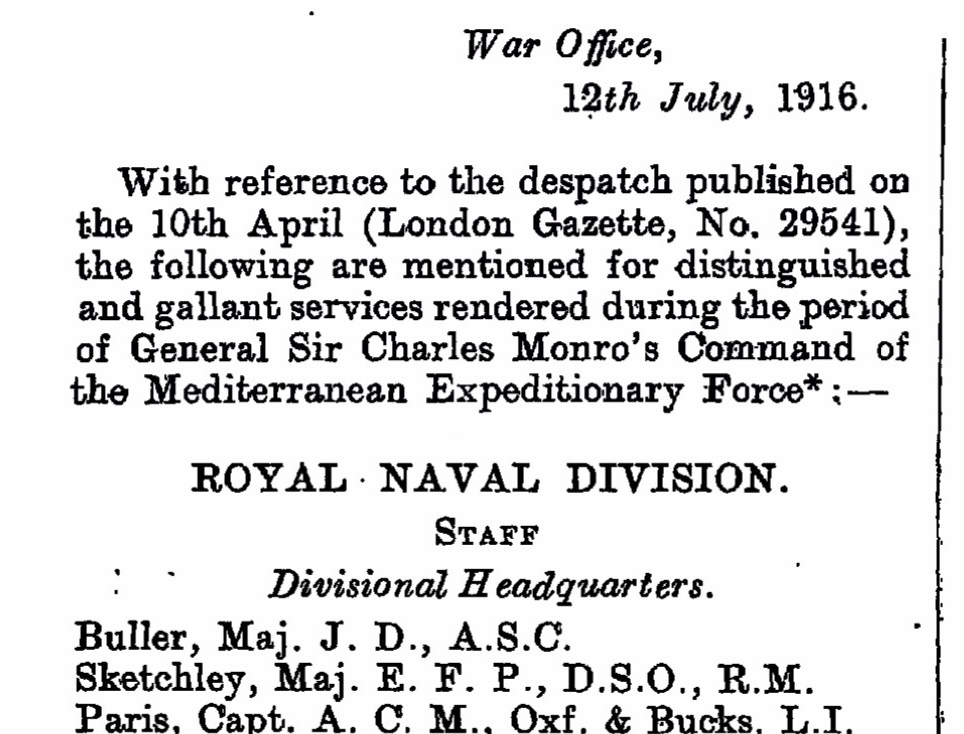 London Gazette, 11th July 1916 On 12th October Ernest was accompanying Major-General Paris inspecting the front trenches when he was caught in a shell blast. It is often cited that he died instantly. This does not appear to have been the case and, from his record, he died shortly afterwards of a skull wound at the 1st (R.N.) Field Ambulance. He is buried in Forceville Communal Cemetery and Extension. It is noted in Ernest’s service record that during his time with the Royal Naval Division “he is quite an exceptional officer…capable, very gallant and popular with everyone”.  London Gazette, 4th January 1917 |
||||