The Internment Enquiry
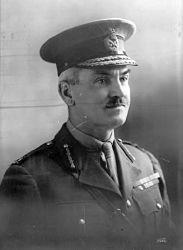
Testimony of Major G.S. Richardson
Staff Officer, Royal Naval Division
TestimonyBackground and AppointmentMajor George Richardson explained that at the outbreak of war he was at the War Office, and was sent over by Lord Kitchener to report to Mr Winston Churchill. He was appointed as a Staff Officer of the Royal Naval Division prior to its going out, helping to organise it at the Admiralty. He was then ordered to Dunkirk in connection with the Marine Brigade, serving with it at Dunkirk, Cassel, and Lille. Major Richardson stated that the First Lord later came over personally and told him he was to go to Antwerp with General Paris, adding that he particularly wanted him to pay special attention to the Quartermaster-General’s department — in effect, the supply side of the Division’s arrangements. Major Richardson arrived at Antwerp on the night the Marine Brigade arrived and remained at Headquarters up to the day of the retreat. The Divisional Conference and the Written Order Major Richardson stated that two conferences took place with reference to the retirement, but that he was not present at the first conference at which he believed some Admiralty officials were present. He was present at the Divisional conference on the evening of the retreat, at Headquarters on the Malines Road, south of Antwerp. |
|
|||
|
Earlier that day, General (then Colonel) Bridges came to Headquarters and asked that Major Richardson meet him the following morning at 5 a.m. at the quay, to be responsible for arrangements for the Division’s crossing of the Scheldt, including preparation of private boats, steamers, tugs, and lighters in case the pontoon bridge broke down. Major Richardson described meeting Colonel Bridges at 5 a.m., collecting lighters and steam tugs, and appointing Marines and naval ratings to ensure they were held ready for the crossing. He also collected motor omnibuses, filled them with food, and sent them across the Scheldt to Zwyndrecht, with additional food placed at Burght, just beyond the pontoon bridge. At about 5 p.m. he was asked to attend the Divisional conference in the town. Those present, as he recalled, were General Paris, Colonel Seely, Colonel Ollivant, Major Sketchley and Major Richardson himself. General Paris informed him that following a conference with the Belgian military authorities the situation had become so serious that it was decided to retreat that night, and he then explained how the retreat was to be carried out. Major Richardson described the broad plan as three brigades moving as far as possible on three parallel routes: the 2nd Brigade on the right with its right on the river, crossing by the pontoon bridge through Burght; the Royal Marine Brigade going through a gate west of the Malines Gate; and the 1st Brigade using the Malines Gate itself. Both the 1st Brigade and the Royal Marine Brigade were to cross by the main bridge in the centre of the town and rendezvous at Zwyndrecht. After discussion as to whether messengers should be used or staff officers should go personally, it was decided that each staff officer should be given a definite task. Colonel Ollivant was to go to the Royal Marine Brigade and conduct it by the designated route; Major Sketchley was to go to the 2nd Brigade and conduct it across the pontoon bridge and on to Zwyndrecht; and Colonel Seely was to go to the 1st Brigade and take it through the Malines Gate, through the town, and on to Zwyndrecht. Major Richardson, having been responsible for river crossing arrangements throughout the day, was to remain on duty at the pontoon bridge and with the craft at the quay until all troops using that route were safely across. Major Richardson then gave evidence of particular importance: he stated that he personally asked whether the orders should not be in writing. One staff officer suggested it was unnecessary, but Major Richardson insisted that an operation of such importance must be written. He wrote the order in his book, setting out clearly what was to happen and the routes each brigade was to follow. He then tore out a copy, and General Paris, standing on his right, read it aloud to those present before the staff officers dispersed to their tasks. Crossing Duties, Bridges’ Car, and Movement to Bruges Major Richardson stated that he remained on duty at the quay and pontoon bridge until nearly midnight. He recalled receiving a written statement from General Paris that all the 2nd Brigade were clear across the pontoon bridge. At about 10 p.m., he believed, the drawbridges of the southern gates were blown up, severing communication between him and the interior of the town. He assumed that the columns crossing through the town had already gone over by the main bridge, which he could not reach or communicate with. With a small party including Lieutenant-Colonel Tupman, Major Richardson crossed the Scheldt in a small steamer. The first person he encountered connected with the Division was an officer chauffeur with a car belonging to Colonel Bridges. Major Richardson stated that he later learned this car was supposed to have belonged to the 1st Brigade. The chauffeur was under instruction to wait for Colonel Bridges, but Major Richardson, believing Bridges to be far ahead, got into the car and proceeded to make his report to General Paris, meeting him at Beveren Waes. General Paris informed Major Richardson that Germans were across the Scheldt near Lokeren and that the Division would move on to St. Gilles Waes and entrain for Bruges. Major Richardson arrived at St. Gilles Waes the following morning, describing units as disorganised with no cohesion and no possibility of reforming or obtaining reports. Trains were available and troops were pushed on as quickly as possible and sent on to Bruges. Major Richardson suggested he should proceed to Bruges to make provision for feeding the men on arrival; General Paris directed him to do so, and Major Richardson arranged supplies of beer and other food at the station. Later they proceeded to Ostend, and Major Richardson stated that it was not until the day he left Ostend that he learned the 1st Brigade had not arrived, this being confirmed by the arrival of two officers, which he thought were Lieutenant Modin and Lieutenant Grant (Benbow Battalion). Major Richardson accompanied General Paris and these officers back to England in a destroyer to report to the First Lord. Confirmation of the Written Order and the Intended Routes In further questioning Major Richardson confirmed that he urged the order should be written, that he wrote it in his book, and that General Paris read it aloud at the conference. He stated that he would not swear whether the three staff officers carried written copies away, or whether they wrote down the order from dictation; what he would swear to was that he wrote the order and still had the original in his book some weeks afterwards, when General Paris asked him for it for his report. Major Richardson then tore it out and gave it to him. He stated that he had no reason to believe the orders were not communicated in due course as ordered by General Paris. He also confirmed that the different routes across the Scheldt were laid down in the written order and that these routes were not only planned but reconnoitred in the morning. Questioned on whether any officer was told off to look after St. Anne’s Bridge, he stated that none was detailed, it being anticipated that the staff officer with the column would make arrangements with that column. Modin and Grant Major Richardson was questioned about the first authentic news concerning the 1st Brigade, which came through Modin and Grant, though he stated they gave it to General Paris rather than to him. He confirmed that he was present when Modin told his story to the First Lord, and recalled a strong impression that Modin sought to present himself as having resisted being marched over the frontier. Major Richardson said he did not remember who gave the order that Modin was to go over the border. Assessment of the EvidenceMajor Richardson’s testimony is significant because it provides a staff officer’s account of the mechanics of the withdrawal order: the conference, the decision to assign named staff officers to named brigades, and the insistence — against initial resistance — that the order be written. His evidence reinforces the impression that the withdrawal plan was conceived as a structured operation with defined routes and responsibilities, not as an improvised flight.At the same time, his account exposes how quickly that structure depended on assumption once physical communications were severed. Major Richardson remained committed to the pontoon bridge task and could not observe directly what happened to the columns withdrawing through the town. When the drawbridges were blown and communication with Antwerp ceased, his belief that the other brigades had already crossed became inference rather than confirmation. His evidence also adds another strand to the recurring “car” problem. His encounter with the chauffeur of Colonel Bridges’ car — which he had later learned was intended for the 1st Brigade — sits uncomfortably alongside other testimony in which loss of transport directly affected the ability of senior officers to locate, communicate with, or control brigade movements during the critical hours of retirement. Finally, Major Richardson’s answers on Modin and Grant illustrate the limits of post-event reconstruction. He confirms their role in bringing “authentic” news of the 1st Brigade’s fate, but cannot speak to the orders under which they moved. This combination — strong clarity on the intended plan, weaker certainty on what was actually communicated and confirmed in the darkness — makes his testimony a useful hinge between the planning of withdrawal and the later confusion over what became of an entire brigade. | ||||
|
|
|